
.
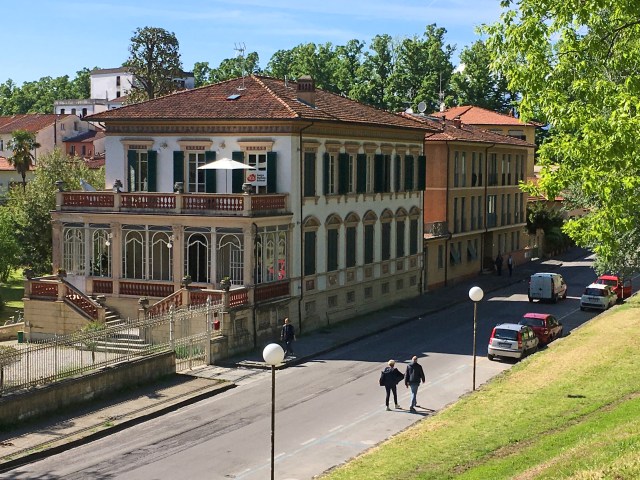
The Lucca Italian School
.
First week of our Tuscan adventure has been given over to a week of deep immersion at the marvellous Lucca Italian school. Where the only non-Italian sound to be heard is the occasional furtive English whisper.
.
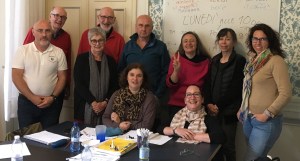
The Students
Great crowd of enthusiastic students of varying ability. Myself a rank beginner and Sweetiepie an Intermediate. Outside the class-room the students gather for cultural, social and gastronomic stuff. My key phrase for the week is “sfortunamente boh” which apparently means “unfortunately no”. Somewhat reflecting the progress to date. But it has been very entertaining. Italian should be simple. I try to follow the Italian example by waving my arms about when talking. Good for the circulation and exercise, doubtful for communication and bad for knocking things over.
.
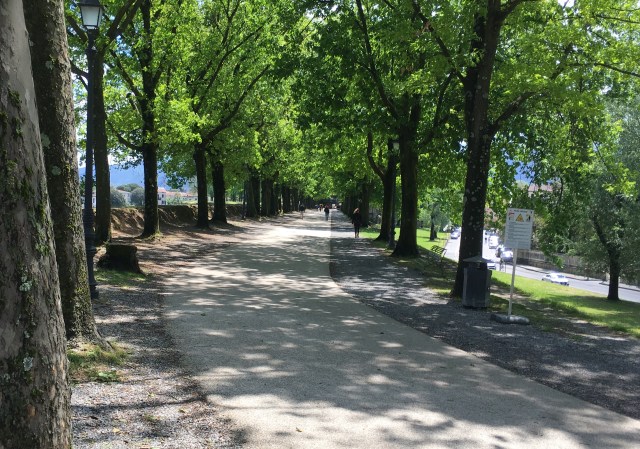
Top of the Wall
Key feature of Lucca is the famous wall. Current wall is the fifth after the original Roman wall enclosing the Amphitheatre, where we now roost at the top level surveying the action below. The wall is about 5 km long, 12 metres high and for the most part about 12 metres wide. There is a wide road on top between a continuous avenue of trees. At intervals around the wall there are ten “Ballurados” – fortifications that accommodated troops, ammunition and weapons. The now grassed area of most of the Ballurados is large enough to allow football fields.
.
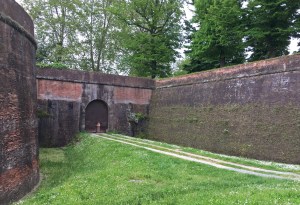 The outside of the wall is sheer brick, surrounded originally by a moat. The inside of the wall is a grassy slope down to the inner road. Somewhere about a million 6 x 4 trailer loads of rocks and dirt would have been needed to build the wall. Not to mention the bricks – Can you imagine the sort of brick factory that would have been needed? And who did all of the sweat and blood? You choose. Slaves? Certainly! Check out & download a 471 page PDF on medieval Italian slavery. Possibly hungry serfs also helped, and maybe a few people who might have been nervous about the advancing Florentine army.
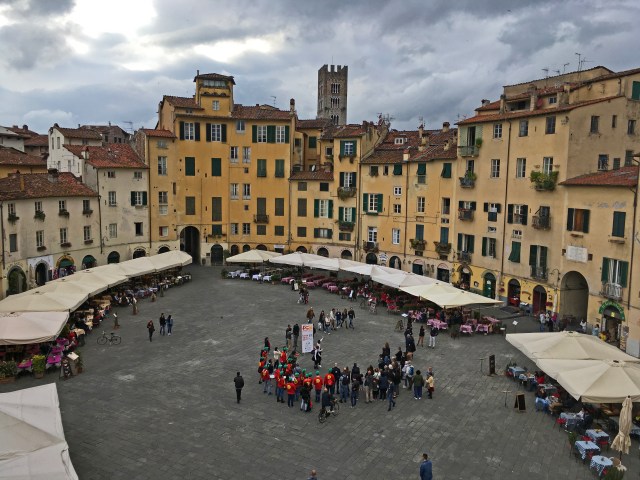
View from our apartment on high
For the next two weeks we are in a quirky artist’s apartment, high above the iconic Anfiteatro. Quite likely the best foreign accom. we have had. Ever. But there is a price to pay. The stairs are steep and narrow. No front door onto the main tourist drag, but the dark steep first two flights are enough to discourage any would be ne’er-do-well. The next flight is even steeper and narrower, so steep that it is safer to come down backwards. The final eight steps from our front door to the living area would need pitons, crampons, hard hats and ropes for proper occ. health and safety. But once inside, totally wow plus! Comfy sofas, hammock to lie in and take in the action below, Shower – tick, kitchen – tick, fast wifi – tick, heating, cooling, bed – tick tick tick. Previous tenants were not so keen about the noise from nearby Osteleria. Hey! This is party time! and anyway, the noise eases off by 1 am. Deli, Gelati, Supermart downstairs and just ’round the corner.
The fast Lucca to Prato train stops at about 5 cities and takes only an hour. About the same time as the Belgrave to Flinders St. service at home. Spent the day in Prato with a dozen classmates from the Italian school, taking in the ancient history and the current culture. Many Melbourne people know about Prato because of the campus of Monash University here.
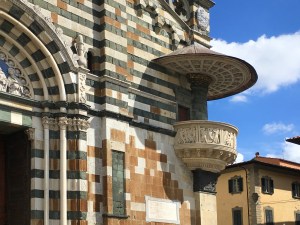
The sacred girdle is the deeply venerated belt of the Virgin Mary, a relic kept in the Prato Cathedral. A narrow strip of gossamer fine wool brocaded in gold thread has been for centuries the city’s most precious treasure. Legend has it the belt, consigned by the virgin to St. Thomas at the moment of her assumption, was brought to Prato from the Holy Land around 1141 by the merchant Michele and donated on his deathbed to the church. Very soon the relic became the subject of extraordinary veneration. Outside the cathedral is a copy of an immense pulpit designed by Donatello and Michelozzo depicting the story of the belt. Five times a year the girdle is displayed to thousands of the devout from the pulpit on high. Down in the crypt, the remains of the real pulpit can be seen by the public, along with a copy of the girdle displayed under the pictorial narrative of the event painted by Bernado Daddi around 1337. The real girdle is kept somewhere secret in a strongbox locked with three keys.
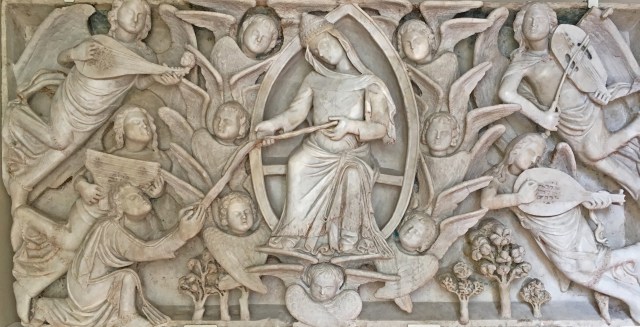
Also impressive is a deep relief panel carved from marble depicting Maria handing the belt to Thomas. Remarkable both for the supreme technical skill and for the emotional description of the moment. Equally impressive are the monumental frescos of Lippi throughout the cathedral.
.
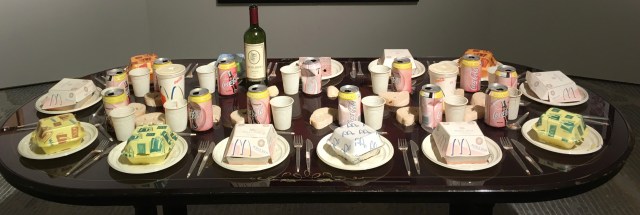
And now for something different. In the Palazzo Pretorio the temporary exhibition is stirring and often confronting. In pride of place is an installation by Karel Trinkewitz titled ‘Jesus Christ Superstore – Dinner for twelve’. Suggesting possibilities for a latter day last supper.
.
Cities like to have icons. Sydney has the opera house and harbour bridge, Melbourne has trams, Prato has the girdle of the Virgin Mary, and Lucca? Lucca has Giacomo Puccini. He was certainly born in Lucca into a multigenerational musical family, but moved on to other places when he became famous. And now, Lucca claims Puccini as its own by having a Museum in his honour near the house where he was born.
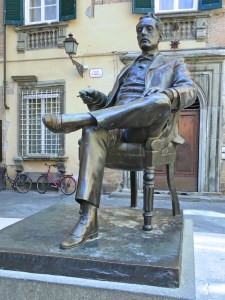
Giacomo Puccini
Many enthusiasts banded together exactly 80 years after his death to form the Puccini foundation which is called “The Festival” to keep alive his memory. Thoroughly enjoyed the nightly concert they stage at the church of San Giovanni. Different program every night. Possible because the festival has a company of 60 professional singers, 4 accompanists, 2 symphony orchestras, 2 choirs, 4 conductors and a staff of 20 collaborators. Visit www.puccinimusic.com for details of access to 250 hours of HD streaming of the best of their concerts – Since 2004 they have produced almost 380 concerts every year
 scatterbrook
Sounds wonderful Bob and Helen! I wonder how many weeks of immersion it will take to learn Italian. Sounds fun anyway. Enjoy yourselves. Love, Virginia