
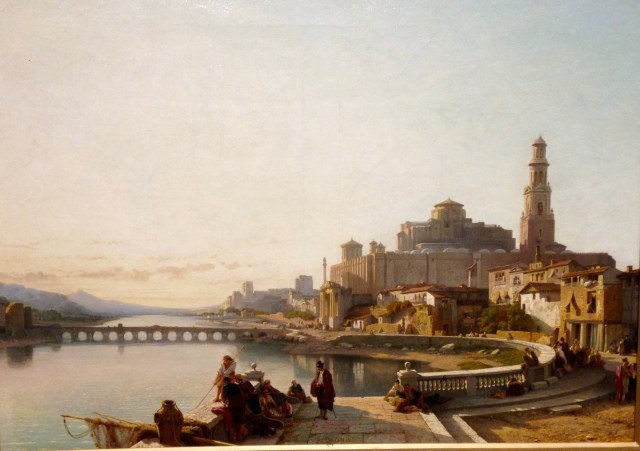
Cordoba is the loveliest place at this time of year. Busloads of tourists are easily swallowed up and dispersed among cute little blue and white alleyways. There is always space at the corner tavernas and cafes to sit, lean back, close the eyes, and after a pause, open the eyes, lean forward, enjoy a café con leche or copa rosada and repeat. There is little sign of plant life along the tall narrow streets except the occasional window box of geraniums.
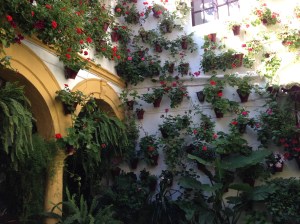
Behind the big thick doors there are private courtyards that they call patios, open to the sky but surrounded on 4 sides by high walls with windows and balconies giving onto the communal area. In the old city the houses are all very old. Although cleanly rendered bright white, decay goes on. And it is easier to cover cracks and crumbling masonry with hanging pots of geraniums that to tackle repairs. So competition has developed for the patio with the best garden display.
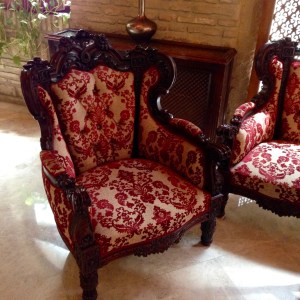
Of course, this is the furniture of pirates and gypsies. Around town there is a sea of pale English and German tourists. The locals all lurk in secluded patios. Little old ladies with the faint beginnings of a moustache just itching to squeeeeze into their flamenco frock and dance by the light of the moon. Hunched, swarthy old men, morose, no longer able to be a pirate because their parrot has sadly died. “I know, because a very wise old Turk told me”. The locals don’t choose to speak much English. Clearly, pirates and gypsies can’t be bothered with Englis (sic) – second language lessons. From time to time people ask me, “Guru Bob” they say, “Where do you get all this stuff? Google? Imagination? Lonely planet? Inside information? Intuition?” – “Sometimes,” I tell them, “but mainly I channel the profound wisdom of the martyr, St. Jadugara the almost believable. We did, however, see a modern day gypsy, dark and hairy. Sitting on a parked motor scooter, he was playing a set of pan-pipes while touting for business. On the back of the motor scooter a serious electric bench grinder was mounted. Reckon he was a modern day knife-sharpening tinker. Would have loved to have shown you a pic, but you just don’t point cameras at guys like that.
To the obligatory cathedral – The site of the Mezquita was originally a small temple of Christian origin. When Muslims conquered Spain in 711, the church was shared by Muslims and Christians until 784. Then the original structure was destroyed and the grand mosque of Cordoba was built in its place. A few decades later, in the hands of a Moorish caliph, Cordoba claimed to be the biggest and best city in the world. By the time the Christians returned in the 13th cent. the city was already in decline as a centre of power. The Christians didn’t demolish the mosque, possibly for economic rather than political reasons. The building was converted to a Roman Catholic church in 1236 by neatly shoe-horning a Gothic nave between the Moorish columns and adding a bell tower to the top of the Minaret. Overwhelming, but for me emotionally empty.
On the other hand, the pretty little Iglesia of San Francesca sits in a serene cul de sac inviting quiet reflection and prayer.
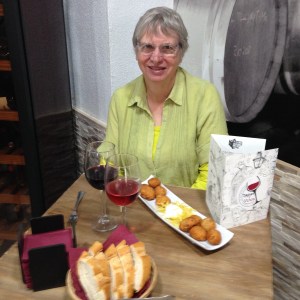
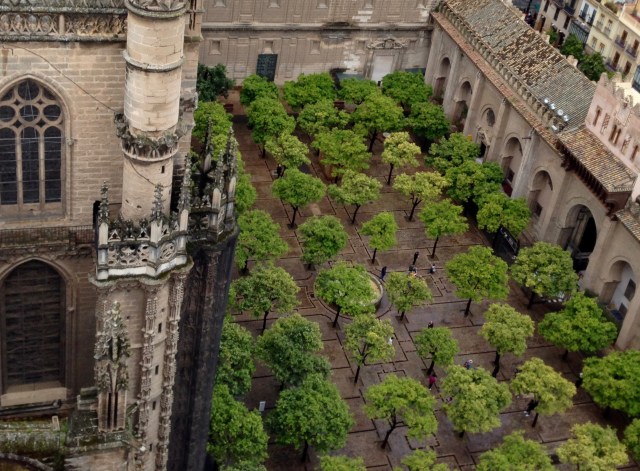
Before Andalucia I could never get into tapas, it seemed to be little bits and pieces that people picked at when they were trying to avoid having a real meal. The tapas here may be no better than tapas elsewhere, but they are the fast food of preference and easy to satisfy personal quirks and preferences. Sweet, fruity, fresh squeezed orange juice is everywhere, more easily available than water. In the countryside groves of orange trees roll off to the horizon. Orange trees are treated with such reverence in the orangeries of mosques and palaces that St. Jadugara privately thinks they might be connected with some form of deity. In the upper class orangeries of perhaps a hundred of so beautifully manicured trees, there is a watering system of channels in the mosaic and brick tiled flooring.
Building repair work happens in the old town, but at a fairly glacial pace. A few years ago, new foundation work among crumbling ruins revealed signs of massive earlier architecture. The building project was shelved/ditched in favour of an anthropological dig. A significant part of a Roman amphitheatre was uncovered. Currently the new Anthropology museum has two floors of exhibits from times gone by while the dig continues in the basement, viewable by visitors.
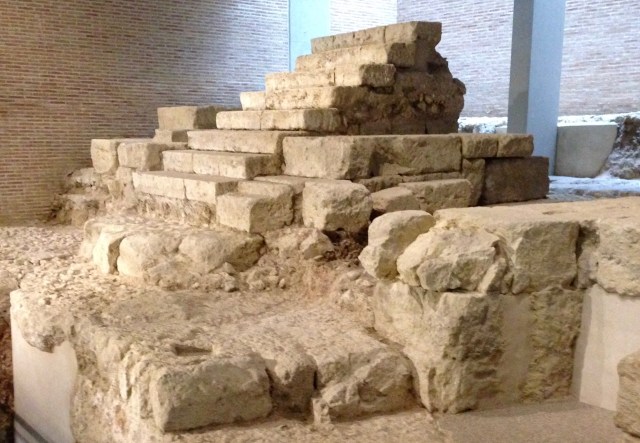
Easy enough to see how it happened in the olden days. Just push over an unloved, neglected old building and start over with the next one, on top of the rubble. Wouldn’t happen in Melbourne – building regs and the need for deep under-ground car parking.
 scatterbrook
Thank you for sharing Córdoba – what a wonderful history