
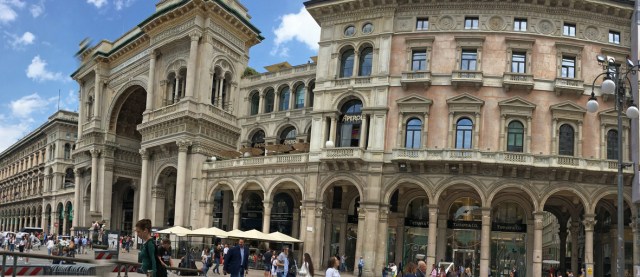
The big three of Milan, La Scala, the Vittorio Emanuel Emporium, and the Duomo, stand together in the middle of town. The Duomo is totally overwhelming. But then, it has had quite a few hundred years to arrive at this point.
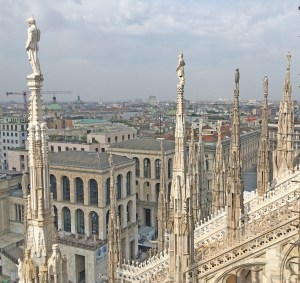
It is very nearly complete, a couple of blocks of marble still await conversion to sculptures. Meanwhile, natural forces are working strongly in the direction of decay. Inside and out, teams of hard hats work high on the scaffolding, restoring and repairing. Such is the program of their work that they have to continually move on, leaving the ornate marble only partly cleaned and restored. It is likely to be some time before the Duomo stands clean and complete, free of scaffolding and hard hats. At the top of the Duomo, the heavy marble roofing tiles sit in stark contrast to soaring spindly spires crowned with statues of the saints, not teetering, just comfortably at home in the sky.

Given the reputation of La Scala, we expected nothing less than the best with a performance of Mozart’s Idomeneo. We played our part by dressing for the occasion. The grand auditorium is geared to acoustics and performance, and succeeds brilliantly. If the audience is physically a bit uncomfortable, that is a small price to pay. Of course, Idomeneo must be sung by the classical tenor and the bad guys by baritone or base. That means that Idamente, the gentle son, must be sung by a higher voice. The obvious answer is by an alto, yes, a woman. Puzzling at first, but it all works out OK.
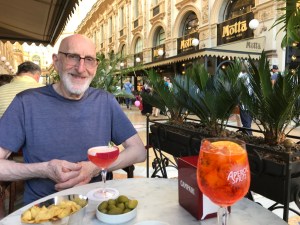
At the majestic Vittorio Emanuel II Emporium, a sea of shoppers and lookers swells past the boutique salons, while we sit in the smug comfort of the famous Camparino Bar, sipping Aperol Spritz and Italian Sours. And further along the street it is possible to lounge, sipping and supping on the rooftop of the swish La Rinascente department store while checking out the Saints across the street on their spires of the Duomo.
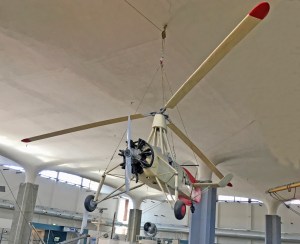 The Science museum in Milan has much in common with other similar collections around the world. The Milan Museum stands apart by emphasising the leading role that Italy played in development of gadgets of all sorts. Leonardo certainly got them off to a good start. So, there is a display of Leonardo designed things produced by an army engineering team. Then there are the planes, boats, torpedoes and trains. Italy did it all first, and so much bigger, faster and better than anyone else.
.
The Italian Lakes, Como, Maggiori, Garda, Orta and so on make a great playground for the rich and famous. The Borromeo family had control of much of the area till Napoleon marched in around the year 1804. Napoleon kindly left them with the Borromean Islands on lake Maggiori. The palaces of Italy often changed hands over the centuries due to squabbles, wars and bankruptcies, but the Borromeans have managed to hold on to theirs through thick and thin to this day.
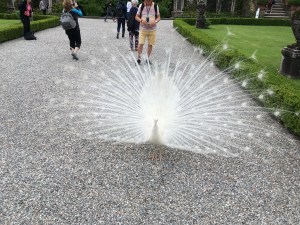
The architecture, the art, the furniture, the tapestries, the gardens have been continually maintained and developed through the centuries. Groups of about forty people are ushered through the grandeur of the Isola Bella palace and then into the terraced gardens with proud white peacocks. The vast gulf between this glittering excess and the lives of ordinary people may be obscene. But the enterprise employs a huge army of staff. The resources available to the gardening staff must make this one of the choice gigs in the country.
.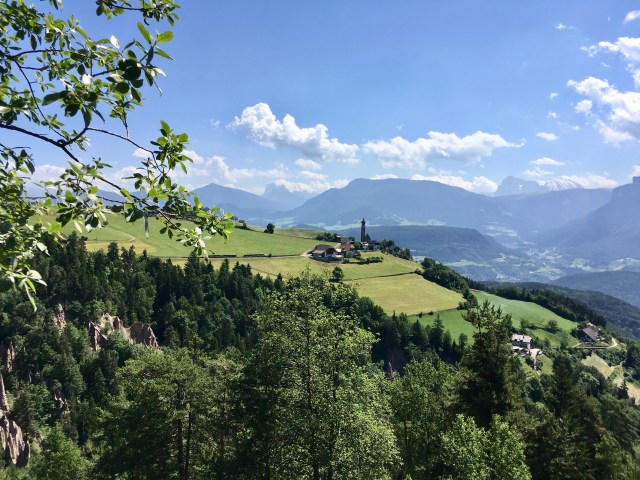
The Tyrolean alps of the Sound of Music spill over from Austria into Italy. Politically it is Italy, but the food, the dress, the manners, the language and rococo church decoration are totally Austrian.
.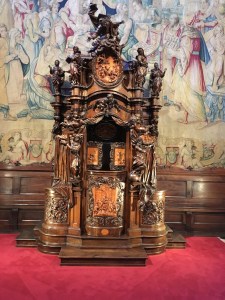
In a church we came across the ultimate confessional. If you have something serious to confess, this is certainly the place to unburden the guilty conscience.
Access to the yodelling hilltops is by funicular railway and cable cars. The contrast between Alpine street music and Milan street music is revealed in the video clip.
.
.
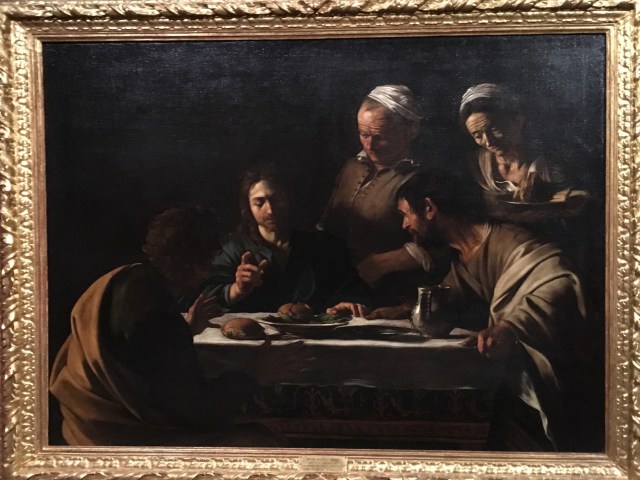
The Pinacoteca di Brera is the serious gallery of paintings in Milan established in 1809, by request of Mary Therese of Austria. Later, at the direction of Napoleon, the collection became a museum with the intention to show the most important paintings plundered by the French Army, paintings from the churches and monasteries of Lombardy were added to the collection, as were other confiscated paintings. At the heart of the Brera is a towering glass enclosed laboratory where the public can watch as master works are meticulously restored and repaired. Paintings as high as 6m are mounted vertically and the restorer sits in a comfortable work station, traversing the painting on a sort of gantry. They have only one painting by Caravaggio, but it is the brilliant Supper at Emmaus depicting the moment when the resurrected but incognito Jesus reveals himself to two of his disciples in the town of Emmaus only to soon vanish from their sight.
 scatterbrook
Thank you Rob and Helen for sharing your beautiful visit to Italy with me. It’s more than 50 years since I was there! XxJill