
Towers, food and wine. The important Tuscan things. As in many places and cultures, the food and wine here varies from the ordinary to the sublime. The range of available Gelati flavours is mind and palate blowing. Our favourite Gelateria is La Crema Matta on Via Fillungo opposite the Torture Museum. We have become such regulars that the boss asked us to put a review on trip advisor. Sweetiepie’s favourite is Zabaglione, mine is Nocchiola con Crema Antica. We’ve been told to say Nosheeola not Knockeeola. Equally good is Dondoli in San Gimignano who twice won a gong for best gelati in the world. Chocolate and Vanilla is always good for a benchmark, and Dondoli produced the most intense death by chocolate ever. A common Tuscan tipple is Aperol spritz – Matta have even produced Aperol Spritz Gelato, Quite OK as a sorbet, but we’d usually prefer a conventional spritz.
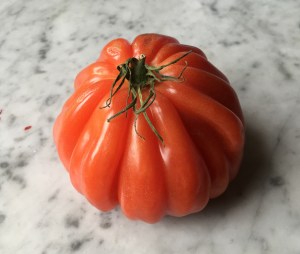
Tiramisu is always good here. So many variations on the theme, all with thoroughly enjoyable exquisite creamy taste, but my own with Rutherglen Liqueur Muscat is still hard to beat. Current favourite cheese is a creamy soft Gorgonzola. Goes well with fine ham which the deli slices so thin it is translucent. The Chianti is jolly, sometimes cheaper than Coca Cola, comes in anything from a plastic bag up to the classic raffia wrapped bottle. Tomatoes loom large on the Italian food horizon in many forms. Came across these strange shaped tomatoes which are very tasty. Rather empty inside like a capsicum. Possibly called ‘Costoluto Genovese’.
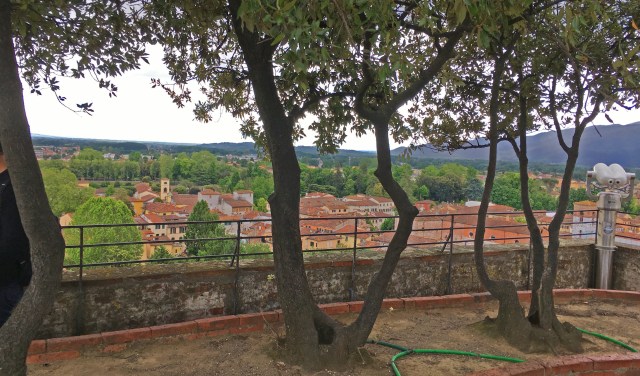
View from atop the Guinigi tower
It seems that in Italy every self respecting Lord and tyrant must have a tower. Because they can. To impress, to imprison, for defence and for the view. In Lucca, Siena, San Gimignano, Prato and Pisa alone there were over a thousand towers in the 15thCent. The emblem of an establishment family was their tower. The taller the better. Paolo Guinigi even had a garden with oak trees on top of his. Now open to the public, who, after climbing 232 stairs, face a sign saying (in Italian) please don’t climb the trees or stand on the wall. The video shows some of the current indoor steps. Back in the olden days the steps went up the outside. Easier defence? The families squabbled a lot way back then. The Montagues and Capulets were mild compared to some of these guys. Paolo Guinigi was locked up in prison by his enemies for being a tyrant. He died there two years later. It was normal practice for the winning family to knock down the loser’s tower. Which is one of the reasons why there are so few still standing. However, Paolo’s tower still stands, not sure if the trees are original. What is it about this tower thing? Is it some sort of blokey phallic competition? In the video clip, these are just a few of the towers still standing. Accompanied by a couple of the resident buskers of the Anfiteatro, whose music inspired me to take a few liberties with the lighting.
At another of the Puccini concerts in San Giovanni the director/conductor Andrea Colombini announced a free Mozart Gala on the next Saturday. Enjoyable concert including a horn concerto, a Sinfonia and a Serenata Notturna. Absolute highlight was the encore “Eine Kleine braw bricht moon licht nicht” with Scottish folk songs Scotland the Brave, auld lang syne and Weel may the keel row all seamlessly woven into the Mozart. In the second encore the left side played straight Eine Kleine while the right side simultaneously played straight Scottish. Could hardly stop from laughing out loud. Italian conducting has to be emotional and expressive. Andrea did not disappoint. In the final encore, facing the Scottish side, loudly stomping his foot in the manner of a warrior preparing for tug-o-war. If you have seen that sort of stuff on You tube please let me know.
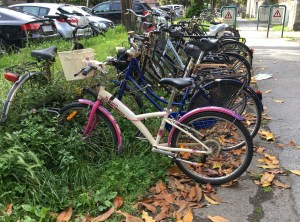
Didn’t decide to grow a beard, just too lazy to spend time keeping tidy. As we are fronting up at La Scala soon to see Idomeneo, thought I should make an effort to be presentable. A charming young ragazza in a nearby barber shop caught my eye and I made a booking. Alas, the trimming was done by a swarthy old guy wearing a pork pie hat while the pretty ragazza looked on. But he did do a good job, nose hairs and all. These bikes were even less tidy than my whiskers. Parked next to the central station, it looks as if all of these people have ridden to the station, fled to Australia and never come back.
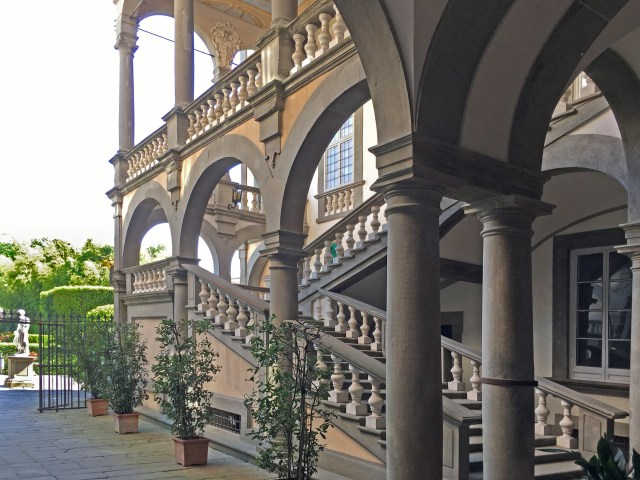
Around the towns, we have so far seen three torture museums. Not in the least tempted enter and gawp. Even allowing for the climate crisis, the refugee crisis, Brexit, intolerance and frequent massacres, still glad to be living today rather than in the bad old days. When we see the grand palaces and churches, it is easy to imagine that they have been that way for hundreds of years. But most times generations have come and gone many times in the course of building, decay and repurposing. The Imposing building now called Palazzo Pfanner was commissioned in 1660 by the noble Moriconi family. Bankruptcy forced the sale as early as 1680 to the Controni silk merchants, newly arrived nobility who built the grand staircase and worked on the garden. Fast forward to the 1850’s when Felix Pfanner from a Bavarian brewing family acquired the estate in 1846. The brewery, one of the first in Italy, was situated between the garden and the cellars of the palazzo. The brewery closed in 1929 but the palazzo is still the property of the Pfanner family, providing a useful movie location including one with Nicole Kidman.
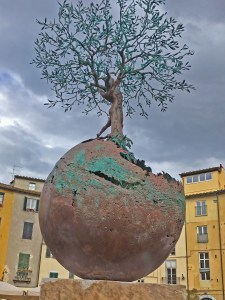
Sculptor Andrea Roggi has a public open air exhibition of his Tree of Life series in Lucca. On Monday, they just appeared. One in pride of place in the centre of the Anfiteatro and a dozen or so along the top of the city wall. They will be there till some time November. Inspired or informed by the Kahlil Gibran text “A young fruit am I, still clinging to the branch and it was only yesterday that I was a blossom. And call none among you foolish for we are neither wise nor foolish. We are green leaves upon the tree of life and surely life itself is beyond wisdom and surely beyond foolishness.”
.
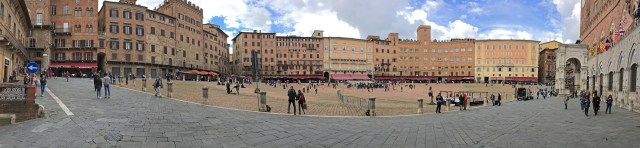
Track for the famous Palio bareback horse race
Two remarkable things about Siena. A church and a horse race. Possibly the world’s most bizarre horse race, the palio alla tonda, first took place in 1633. Three quick laps of the village square in under 90 seconds. There is a raffle to match riders with horses. The race is bareback, so riders frequently fall off and horses sometimes finish the race without jockey. The horse is the focus of attention and may be declared the winner ever without a rider.
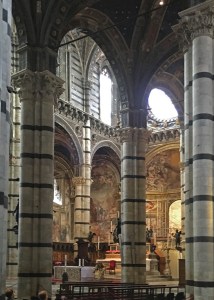
Work on the Siena Cathedral commenced in the early 13th cent. And then there was the plague. A hundred years later a chronicle recorded: “They died by the hundreds, both day and night, and all were thrown in ditches and covered with earth. And as soon as those ditches were filled, more were dug. And I, Agnolo di Tura, buried my five children with my own hands. And there were also those who were so sparsely covered with earth that the dogs dragged them forth and devoured many bodies throughout the city. There was no one who wept for any death, for all awaited death. And so many died that all believed that it was the end of the world.”
After the plague had passed, work resumed on the cathedral century by century with the great artists of the renaissance making their contribution. Wonderment everywhere, from the marble floor decoration to the illuminated choral manuscripts in the library, the soaring glittering dome, Donatello’s John the Baptist. On and on and on. The people who built this must have believed that the world would never end.
 scatterbrook
Ciao, Roberto,
Thanks for sharing your experiences, thoughts, feelings and gelateria tips. On the LIS historical walk we learned that the towers had enormous prestige value, but were primarily defensive: nowadays modern steps at bottom to replace ladders that those under attack could pull up behind them.