
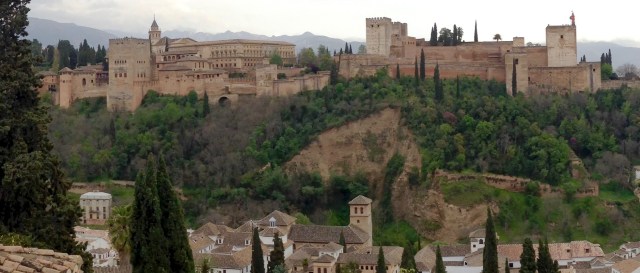
In coming to Granada, the focus of our Andalucian campaign was to visit the fabled Alhambra. Fabled, due to the very popular Tales of the Alhambra written by Washington Irving in 1829. He was an adventurous writer and diplomat (American ambassador to Spain) with an entertaining economy of truth. When Irving visited and stayed in Alhambra it was a romantic ruin that had been trashed by Napoleon when he was forced to retreat from Spain. Irving’s writings put Alhambra on the tourist map and the Spanish government undertook repairs.
We were shocked and stunned to discover that we should have booked e-tickets for the Alhambra at least 5 months ago. Rober our landlord was not encouraging. He thought that there might be a possibility if we climbed the mountain before dawn and waited in the queue of desperate hopefuls. Sweetiepie is not good with queues, so before unpacking, we each attacked the web with vigour on separate electronic devices. After a very intense hour we managed to book tickets to the Alhambra. Only to discover that, not only had we double booked, the tickets were for a very limited night session. Further stressful key-punching revealed a limited release of next day only tickets. After another nervous hour of tail-chasing in the web labyrinth, Amex saved the day.

Rober’s edgy apartment holds many surprises. An absolute triumph of vision, imagination and style over function. Everything in the apartment sort of works, importantly, Wifi is good. Interesting features – One bedroom, smallish bed, upstairs and downstairs showers, both with unbelievably huge deluge shower heads. chain drain, 27 light switches, in-floor heating and thrill ride stairs with no guard rail.

Big picture – About the time the Muslims were being elbowed out of Cordoba, Mohammad al-Ahmar the eventual founder of the Nazrid Dynasty, foresaw a grim future and did a deal with some of the Christians. If they left him alone, he would leave them alone. Might have been a fair deal except that the Frederick II wanted what these days would have been called a performance bonus. However, this did give the Nasrid Dynasty about 200 years of breathing space to develop the kingdom of Granada. The site they chose for home base was the beautiful wooded Sabika hill overlooking Granada. Thus was Alhambra born, and the dynasty lived in great style and grace between 1237 and 1492, during which time a sequence of no less than 22 Nasrid sultans or kings ruled the land.
Then the pompous and mean Ferdinand II of Aragon arrived. Having effectively removed Muslims from the rest of the Iberian peninsula, he put the hard word on Mohammad XII a.k.a. Boabdil. Boabdil was not a hard man and sportingly handed over the keys of Alhambra. End of story. When Ferdinand & Isabella of Castile came to the Alhambra, their first act was to interview Christopher Columbus and bankroll his adventure to what came to be known as the Americas. They then set about establishing the Royal house and beefing up the military headquarters in the grounds of Alhambra. A few years later, Charles V left the utterly in-your-face Spanish renaissance palace unfinished in the grounds of the Alhambra to go and deal with the Turks who were rattling the gates of Vienna. Charles never returned to Granada. By then a lot of the magic had gone, except perhaps for the café in a lovely wisteria covered courtyard that to this day serves exquisite croquettes, as shown in the video clip.
There were orange trees to the horizon near Seville. But on the bus trip to Granada it was olive trees to the horizon. It is said that the olive trees of Spain constitute the largest man-made forest in the world. Ranging from fields of seedlings to stout old stumps like oak trees, still cultivated and producing.
G.B.: “St. Jadugara, however do they harvest such a vast crop of olives?”
St. J.: “Well, Guru Bob, of course it’s all mechanical now. That’s why the rows are so widely spaced, to let the tractor mounted gadgets in to shake the Bejeezus out of the trees and catch the olives. Obvious
G.B.: “Not kind to the trees”.
St. J: “Collateral damage. Why you don’t see many stout old olive trees now – collateral damage to the tractors”.
G.B. “How about the olden days, before tractors, what then. How did they muster enough pickers?”
St. J: “The steward would say to his Andalucian Lord – ‘looks like harvest time, the usual?’ The Lord would say ‘Si’. And the steward would set about mustering the harvesters. Serfs, slaves and, if absolutely necessary, family.”
I like St. J’s explanations, so much quicker and cleaner than Wikipedia. The experts confuse with their arguments. And, in any case far too much reverence is given to the Truth, whatever that is.
The rain in Spain goes mainly down the drain. Absolutely impressed by the Spanish weather forecasters. They predict, more or less accurately, to the minute when the rain will stop. Same accuracy as the trains. Nothing to do with advanced electronic profiling, simply good old-fashioned Gypsy fortune telling.
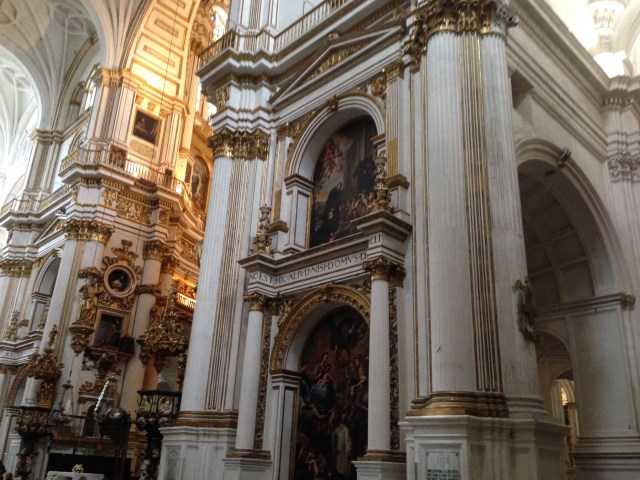
Along with the part finished gross palace on the hill, Charles V began work on the down-town Granada Cathedral. To be completed nearly 200 years later in a glittering morbidly obese Spanish high Baroque manner. A feature above and behind the high altar is a Monstrance of magnificent excess. Monstrance – a lovely onomatopoeic word, but surprising that anyone would admit to owning such a thing.
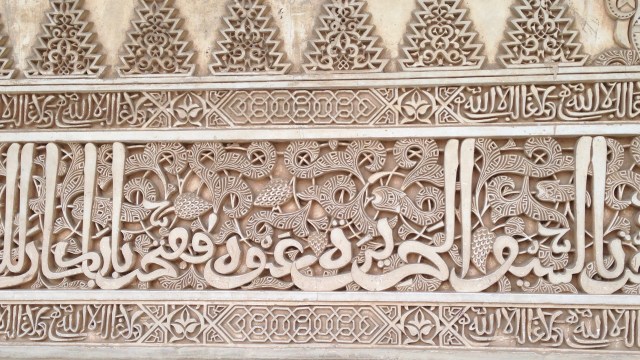
A recurring Muslim decorative medium is the plaster frieze, in splendid extravagance. In such quantity around the Alhambra, it was difficult to imagine the number of man-hours involved in the work. Expert advice is that a Gesso mix of gypsum and powdered marble was formed with moulds. Technically must have been very challenging, but after about 200 years it was still a work in progress.
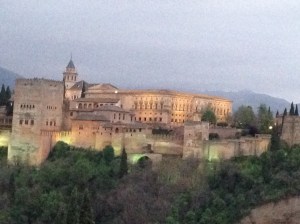
Happened on a superb buttock list location. Mirador = lookout. High on a hill with a panoramic view of the extent of Alhambra. The buttocks firmly in a beautifully squishy two-seater lounge. Passing the time with Copa Tinto and croquettes (what else) waiting for the sunset and eventual floodlit spectacle. One of the compromises this trip was to use only iPhone – not to take a camera. So far the results have been tolerable, but alas the iPhone couldn’t do justice to the light show
From the restaurant perspective, the rise of the towering stonework from the steep valley walls was most impressive. St J could see what I was thinking.
St. J: “How did they do it? Where did they get the skills, the rocks, the artisans?”
G.B: “Yes”.
St. J: “ For hard labour the usual serfs and slaves, the family were too busy having a good time. Building materials presented problems. You can see the variety of different materials and methods in the Muslim walls before they were faced with plaster.”
G.B. : ”The sheer cost of labour must have been crippling”.
St. J. : “Remember there were no Oc Health and Safety rules to impede progress. No workers comp. No award rates or enterprise bargaining. Cheap labour.
G.B. : “What happened to the casualties?”
St. J. : “Sent the broken bones home to the widow.”
G.B. : “Not fair play at all.”
St. J. : “An odd antipodean concept, but no.”
G.B. : “Charles V didn’t seem to have any problems getting the best of materials and craftsmanship?”
St. J. : “Ruthless”
Let me pause to give credit to Sweetiepie the magnificent. Not only is she tolerant of my ongoing bursts of silliness, She is an excellent proof-reader of the blogs and serves to curb my worst excesses. In short, she causes me to be a little nervous about …. Well … inaccuracy. So I recalled that in the mid 13th cent Ferdinand III had done a deal with Mahommad I, while a couple of centuries later Ferdinand II expelled Boabdil. Do the Spaniards count backwards or what? Actually Ferdinand III 1230 – 1252 was of the kingdom of Leon and Ferdinand II 1479 – 1516 was of a different kingdom – Aragon.
At the time there were lots of Kingdoms in what later became Spain. To reduce the confusion they gave them descriptions, names like – Alfonso the battler, Theobald the Posthumous, Henry the fat, Louis the Quarreller, Ordoño the wicked, Charles II the bad, Ferdinand IV the summoned, Peter the cruel, Joanna the mad, Henry II the bastard and Henry IV the impotent. All absolutely true – check with Mr. Google. So the lack of grace in the language of some of our present day Pollies is nothing new.
In the fullness of time how will some of our recent leaders be described? Perhaps one of our captains of industry will be known as Gina the malevolent. Please offer suggestions relating to Malcolm, Tony, Kevin, Julia, Bob and Gough, also Donald, should he come up Trumps in the presidentials, and any others you consider worthy of mention. A ceremonial vessel is offered as the prize for the most colourful publishable entry. Results to be released in the post from Scotland next week, so get busy.
 scatterbrook