
A long tradition of craft can be useful. When the owners of our riad came to repair the badly damaged very old tiled flooring (possibly damaged by donkey feet) they found that tiles of the same shape and colour are still being produced. See the pic of the junction between new and old tiles.
Production of ceramic building, decorative and domestic ware is vast. Very durable practical and relatively easy to produce. Production of mosaic components seems unnecessarily complicated. Wouldn’t it be easier to mass produce little shapes and glaze them just before use? Not really. Little unglazed shapes would be too crumbly, too difficult to handle and glaze. And the resulting components would not have the required sharp edges. So you can see here a bank of mosaic tile chippers in action.
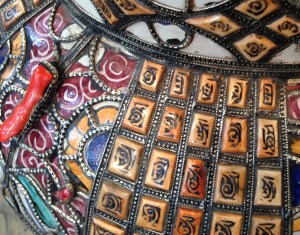
The simplest ceramics are possibly plain roof and floor tiles. Green roof tiles reserved for mosques. From there it becomes more complicated. Increasingly intricate use of mosaics, increasingly elaborate glaze decoration, and use of multi media. Silver work and camel bones are interesting inclusions. Not a clue as to how the camel bones are prepared and attached, but the effect is exotic, bordering on over-the-top.
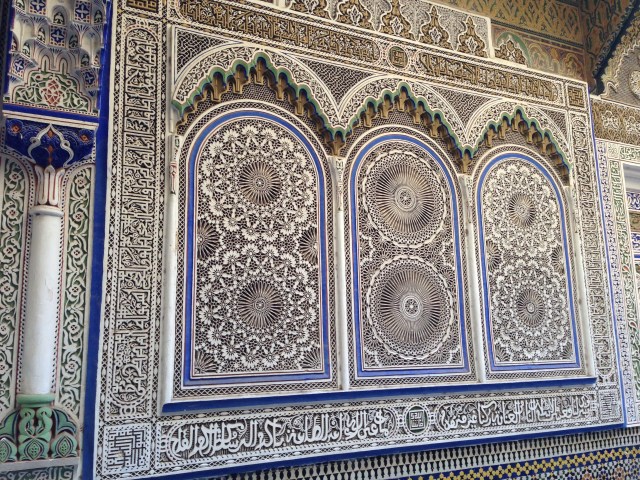
The best of the best is reserved for the mosques and the royals. Motifs in cedar, plaster, bronze, silk and mosaic appear in detail and scale that required artisans to engage in what must have been mind numbing years of repetition without losing precision or the overall picture. The deep relief plaster carving presented interesting challenges. To get the clean sharp edges, the plaster had to be carved at an intermediate degree of setting. Even over large areas the transition between sections doesn’t show. Plaster is a relatively weak medium and suffers damage over the years so that repairs are necessary. One of the mosques is scheduled to close for 2 years for repairs to the art work.
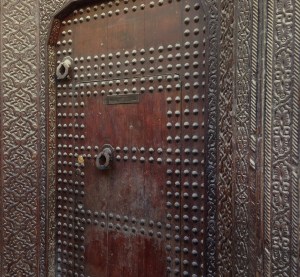
In the olden days there was a door within an outer door at important houses. There were two door knockers. A higher one for male visitors, a lower one for women. According to the gender of the knocker, a man or a woman would answer the door. If a man knocked at the door and no man was at home, a woman would open a little slot, high on the door and ask if the caller wished to leave a message. Conveniently, these days the slot serves for mail delivery.
Courtship was a polite and civilised process. The family of the groom-to-be would call on the family of the bride-to-be. On arriving, the grooms family would leave cones of sugar just inside the door. After the pleasantries, on leaving, if the sugar hadn’t been touched by the brides folks, the deal was not on. If the sugar had been scoffed, everyone was happy. Partial sugar removal was code for “Work in progress, possibilities exist”.
Moroccan brocade – weaving characterizing intricate raised woven patterns – is patronized by the rich and famous world-wide. Gold and silver containing silk thread is used in most of the work. In Europe, Jacquard looms mechanized weaving of intricate repeat patters.
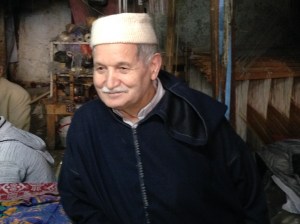
But in the Moroccan system one weaver operates the complicated tangle of heddles while another works the shuttles and beating. Had the pleasure of meeting Abdelkhader el Ouazzani the one man in the world who does hand worked brocade. Only royals and the über rich of the world can benefit from his skills.

Over the years Fez, a settlement by a river, grew and grew to become, from time to time, the seat of government and home of kings. Around the time it became a walled city, pressure for building space became so intense that the river was absolutely contained within stone walls and built over. Near the Rcif building density eases and the fast flowing river emerges for a while between concrete banks so steep that it will never flood. Only to unaccountably disappear again somewhere near our riad.
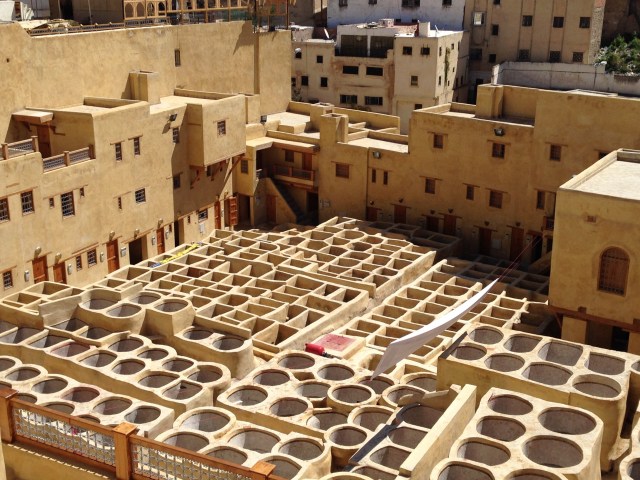
This is the area of the tanneries. The work is hard and smelly and doesn’t pay very well. But needs must, and there are many workers. It is not just a cute custom that sprigs of mint leaves are given on entering a tannery. Mint leaves stuffed up the nostrils helps to control the nausea. The tanneries produce goat and cow leather. The highest quality is exported, and used by the fashion houses of Italy and Japan. Every-day quality is made up into bags, shoes and jackets in the Medina for sale around the souks.
The man in the grubby Jelaba has been seen trading again. This time only three Dirhams changed hands. What IS he selling?
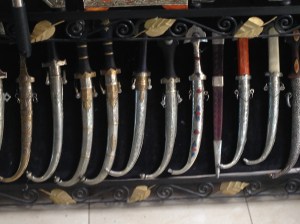 The Seffarine, taking its name from the coppersmiths of the area is along the way from the tanneries. The metalworking hub of Medina, it produces bronze, copper, brass and iron wares by unchanged medieval methods. The constant beating of copper bowls echoes around the Medina for 12 hours a day. The only concession to modern times being substitution of an electric blower for the bellows by a blacksmith. Moroccan daggers are called Koummya or Jambiya. The curly end of the scabbard might seem to be a flippant affectation. So the story goes, the idea was for a warrior riding full tilt on his donkey/camel/horse, reins in one hand, to take the handle of the Koummya in his other hand and catch the curly bit of the scabbard in his belt to enable him to draw and fiercely brandish the weapon. Got the idea?
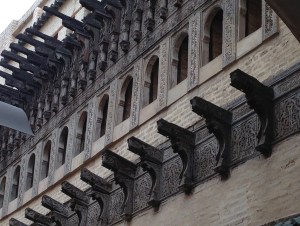 Lunched most days at the Clock Café, named after the so-called Clock House. In the fourteenth century a magician invented a water clock to measure the hours. Each passing hour, by means of water and mumbo jumbo one of a row of thirteen windows high above the street would open. Enabling people to tell the time. The clock stopped working when he died, as he failed to tell anyone the secrets of the device. The bowls have been removed since 2004 and the clock mechanism is presently being reconstructed by ADER, a foundation for the reconstruction of monuments in Fes.

There were at least two famous Fatimas. Representations of the hand of Fatima Zahra, daughter of the prophet Muhammad, are fashioned from many media, often in brass and appear in places like door entrances and earrings, they are thought to ward off effects of the evil eye.
Fatima Al-Fihri’s family came from Tunisia in the early ninth century. Her father went on to become a very successful businessman. After the deaths of her husband, father, and brother in short succession, Fatima and her sister Mariam received a sizable inheritance. Fatima founded Al-Qarawiyyin Mosque and University, considered by many historians as the oldest, continually operating university in the world. Historical references note that she directly oversaw and guided the construction process in great detail, certainly a testament to her great dedication as she had no expertise in the field. A public spirited example sadly not followed by many other women of great wealth in the world.
 scatterbrook
Your efforts to communicate are really appreciated Bob. A wonderful adventure and we’re loving traveling along with you all.
Thank you once again for the “potter,s view” of Fez. I so enjoyed and could relate to the tile making! The photos are so enlightening. Live to you both.