
Before leaving Hagetmau, went to the Intermarche to get cash from a hole in the wall. Found extremely large hole in the wall, police everywhere & no cash to be seen or had. Local lads had been at work with heavy earthmoving machinery, one assumes very politely.

hole in the wall
Travelled by small plane to the airport at Marseilles. Small aisle way and pointy overhead doors not really compatible with tall bald blokes, so blood everywhere, but only a flesh wound I am told. Met at the airport by Bernadette & Patrick who are new to homelink, enthusiastic & good fun. Pyrenees are characterised by broad green rolling acres of corn and sunflower farming, whereas cote–de-Provence is a wine region, and the vines do very well, but the land seems so much drier & rockier. Further north in Provence is lavender country, but not blooming just yet. Many happy fat Charolais cattle lounging about.
Home this week is a ‘Garconiere’ in a little village near Aix-en-Provence. Seems a Garconiere is a separate apartment for a grown up boy who refuses to leave home. Sound familiar? Hosts speak as little Australian as we speak French, but hospitality speaks all languages. A neighbouring Scottish lady, Elizabeth married a Frenchman 30 years ago and lives in a mini farm on the top of the hill with a couple of ponies. English speakers who settle on this side of the channel usually manage to integrate into the local communities, but there is an inevitable tendency for them to huddle together. Elizabeth, speaking fluent French, embraces both camps. Some time ago she started an English – American expat association, which has also attracted a few local members. They have a bridge afternoon every Tuesday, this being Tuesday, and they being one person short on a table, led to involvement in the Bridge equivalent of hit-and-giggle tennis. Expats are by definition not normal, and some of the individual rituals and bidding habits are a bit strange. But so polite, lovely afternoon tea. Turned out that my partner for the afternoon also has convict ancestors, John Cropper was a minor criminal, transported to Tasmania, whose son Abraham was a gold miner at Sofala NSW before migrating to England. Must check if they are in the Lucas Gascoyne book.
Have been watching very little TV – the live entertainment being much more diverting – But the royal wedding was a must, hopeless romantics that we are. The only other TV has been the Monty Python Holy Grail with French subtitles, adding yet another layer of the absurd onto the ridiculous.

style
It may be true that some small village markets are losing business to Intermarche and Carrefour, but the weekly market at St Remy is an utter delight. Lots of little squares and the joining alleyways are lined with interesting stalls. Clothing, kalimba thumb pianos, cheese vans, sausage stalls, cheese vans, jewellery, cheese vans, an asparagus stall, and oooh! just smell those spice stalls. Settling in at a café overlooking a small square, Sweetiepie & I have our usual – Coca and Espress as we take in a five piece jazz combo doing ‘Avalon’.
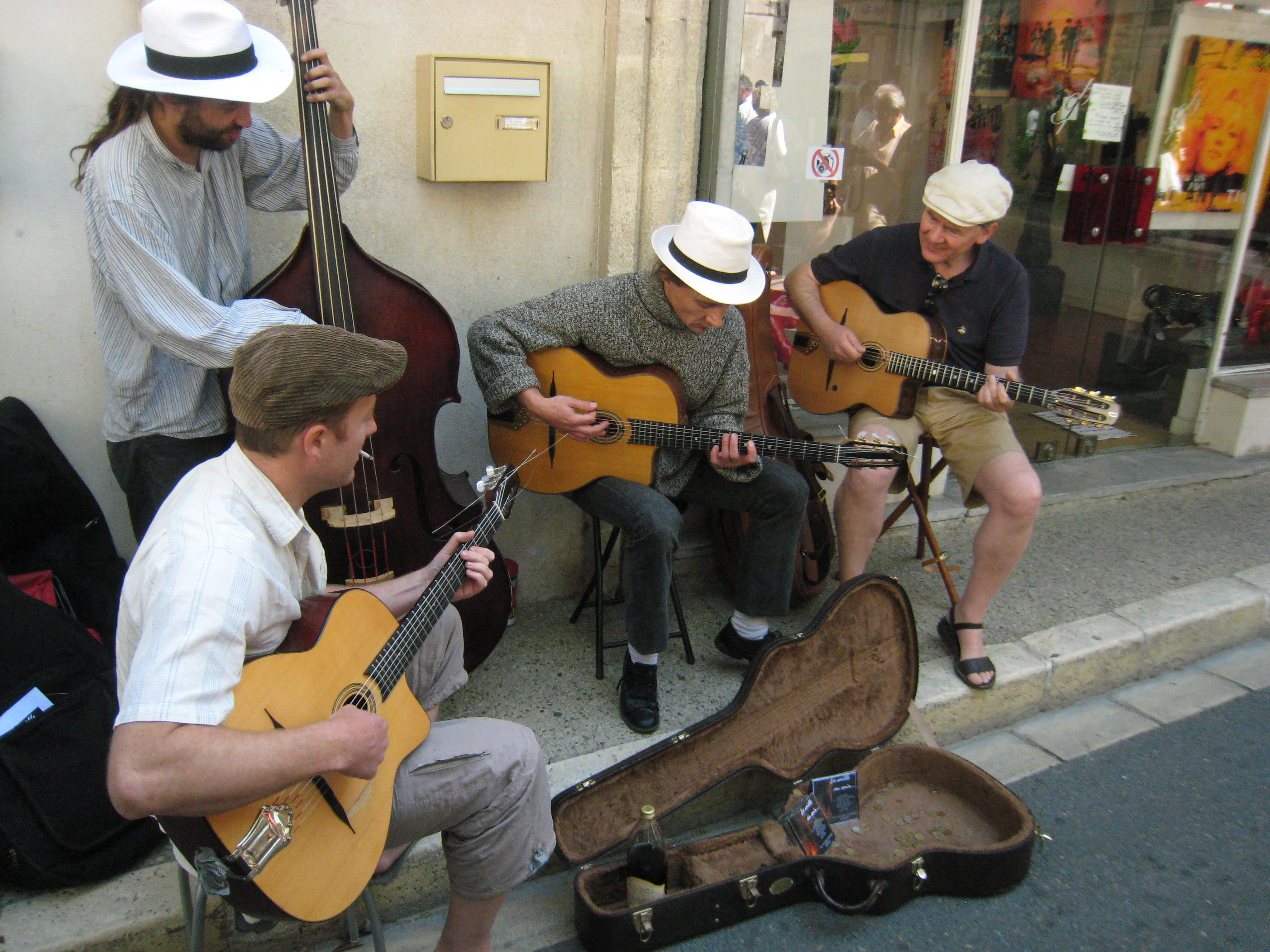
Jamming in St Rémy
Endlessly fascinated by the ‘who, where, when, why and what’ of old piles of stones. Five very different piles of stone are: Notre Dame de Garaison in the haute Garonne, Baux, a once great in-your-face garrison chateau on a highly defended hill top, The Cathedral at Aix-en-Provence with its 1500 year history, Glanum, the Gallo/Greco/Roman ruins south of Rémy and Saint Victoire, the grandest of all.
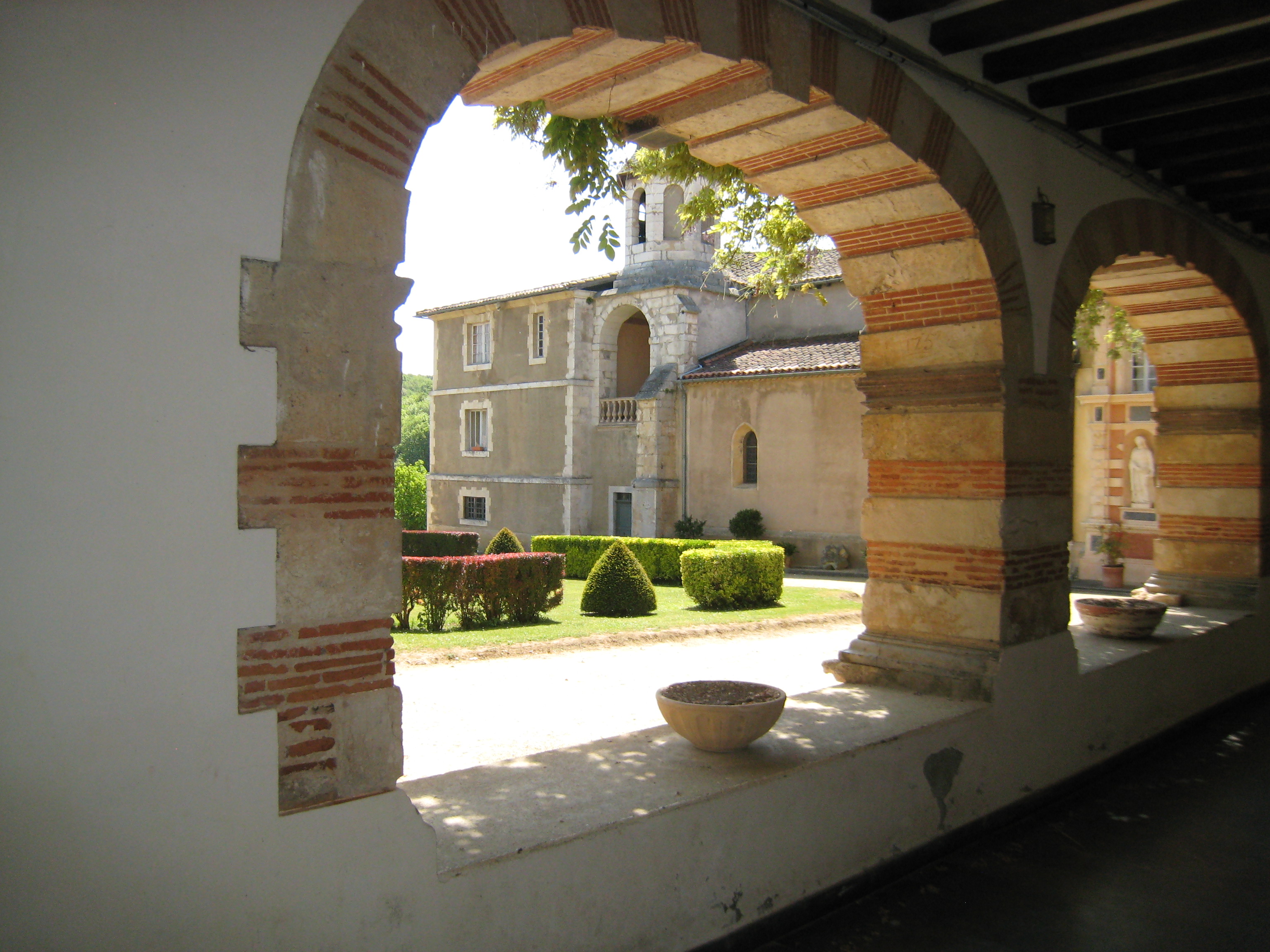
N.D. Garaison cloisters
So many of the holy places in France are dedicated to various “Our Ladies” that the appellation is reduced to initials. N.D. de Garaison began life as it continues, a pretty collection of buildings set in isolation on a beautiful hill-side. As early as 1590 the chapel was pillaged but the Madonna resisted the flames. In 1604 Pierre Geoffroy organised the sanctuary and established a community of chaplains and “the miracles multiplied”. Over the centuries ecclesiastic life continued, N.D. de Garaison being consecrated in 1865. The fathers were expelled in 1903 and the building served as an internment camp 1914 – 1919 and since 1923 the complex has functioned as a college.

A Baux war machine
Baux, funnily enough, is a great mountain, whose mineral was recognised in 1821 by Pierre Bertin and named ‘Bauxite’. Just the sort of mound that demands ‘I’m the king of the castle’ sort of struggles for and assertion of power. Massive heavily defended fortification above large colony of stone houses built into the hill-top. Apparently successfully defended for a few hundred years till early in the 18th cent when most of the castle walls were destroyed by royal decree, ordered never-to-be-restored. The remains attract convoys of busses of tourists to the ‘Chateau de Baux’. Arrived just in time to see a demo of a couple of giant catapult stone-chucking siege engines. Takes eight volunteers operating the twin treadmills to pull the chucking arm into place by raising the huge counter weight. Couple of little boys easily cajoled into pulling the trigger at count of 3. So the story goes – these machines were used as defence against attacking cavalry, claiming that a good team could fire a rock a minute and decimate a decent cavalry charge. Hard to imagine anything more than scare value. It is said that in time of siege, after all the big stones had been chucked, any nearby big object was flung at the enemy. Sounds very Monty Python positive. Apart from the usual tourist tack for the masses, popular souvenirs with little boys are wooden swords and crossbows with foam headed arrows. The French kiddies seem to be much more polite and refined in their swordplay than their Anglo-Saxon/Aussie counterparts.
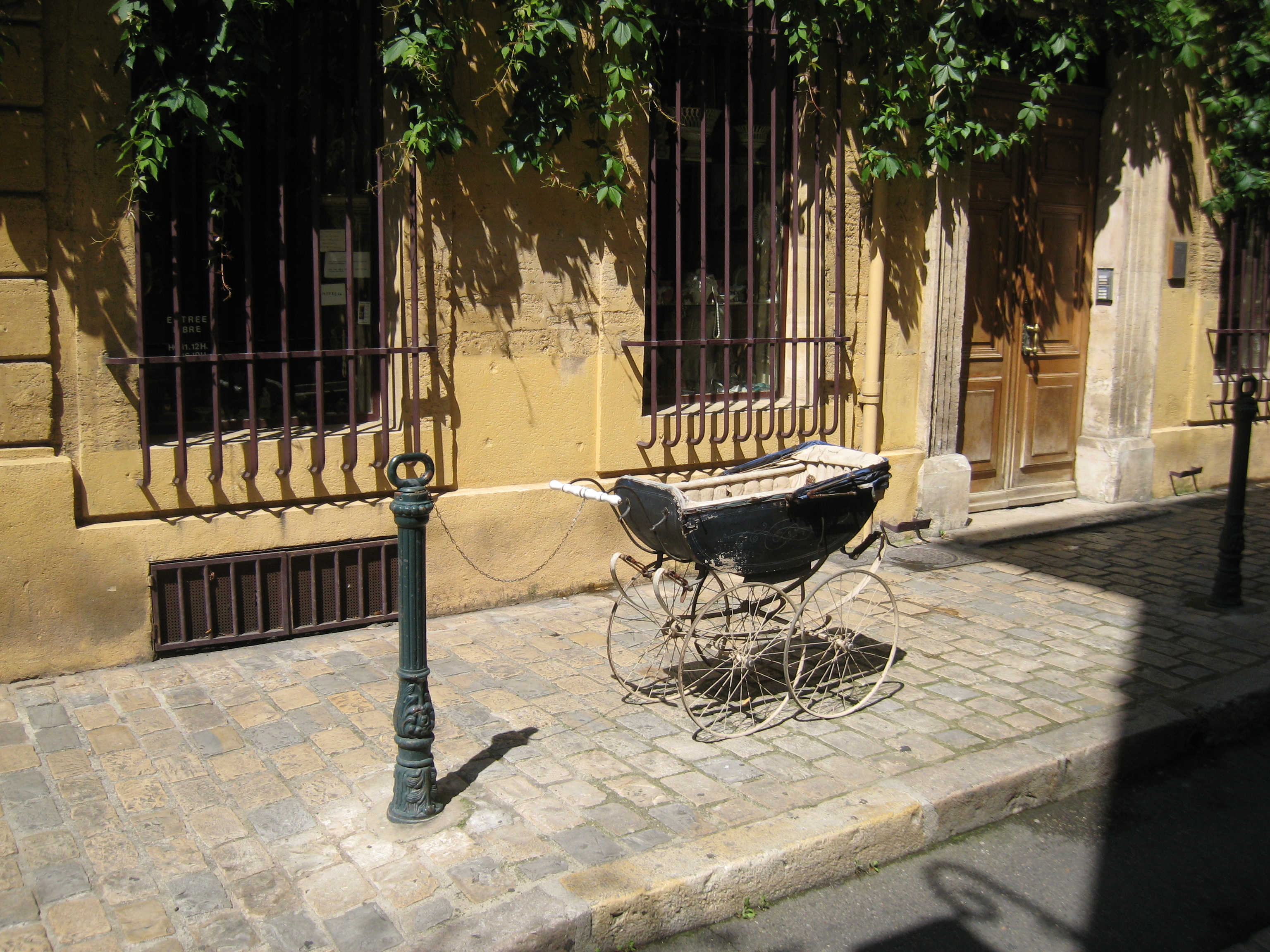
easy parking
The town of Aix itself is big, old, interesting, and very busy. Bit of a parking nightmare, found ourselves doing laps of the city looking for either a park or a way out. The site of the Cathedral has been a place of worship for over 1500 years. The proportions as a whole hang together well. A couple of tombs are all that remain from the 5th cent. From the 10th century, most of the additions, repairs and modifications leave the marks of their time, the baptistery equipped for full immersion baptism, the elegant renaissance pillars of the nave, stained glass from a number of periods, and handsome twin organs above choir stalls either side of the nave. Sunday afternoon, after the brocante market, half a dozen music students gave one of the organs a good work out with a free concert by way of practice for their coming prac. exams. Interesting that a provincial music school has so many organ students. Difficult to know how much of their repertoire is sacred & how much secular. One piece in particular was quite challenging. Can it be that sacred is going ‘cutting edge’? Didn’t feel all that spiritual.
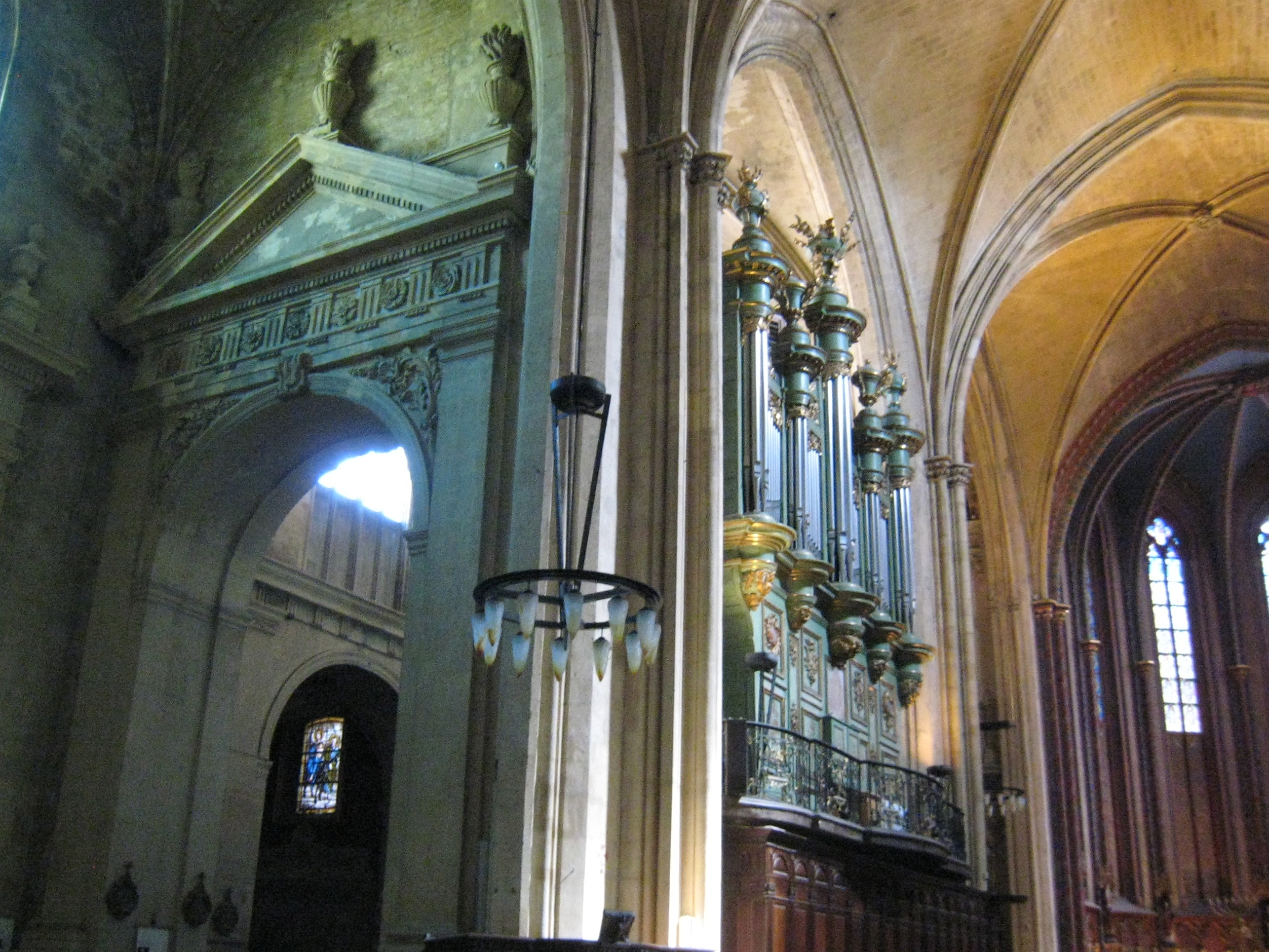
Aix-en-Provence cathedral
Galum has even more history. The Gauls set up shop here about 450 B.C. The Greeks moved in for a century or so till pushed out by the Romans, who made quite a mark. “What have the Romans ever done for us?” Well, for starters, acres & acres of circa 100 AD town houses, twin temples, hot and cold baths and the tepidarium for something in between. Most outstanding relic is the mausoleum, which was built of the very best marble from the Roman world of the time – about 100 BC. Around the plinth, which stands maybe 5 metres high, are deep relief carvings of battles won and lost. Facial features are a bit indistinct, but apparently this is the best-preserved outdoor Roman monument in the world. Second level consists of a four bay Corinthian arch with a mix of triumphal and funerary symbolism, topped with a circular conical roofed, Corinthian pillared dome. The only thing missing being the acroterion (top knot sort of gadget). Wonder if the Grollos could make something big and impressive that would last 200 years?
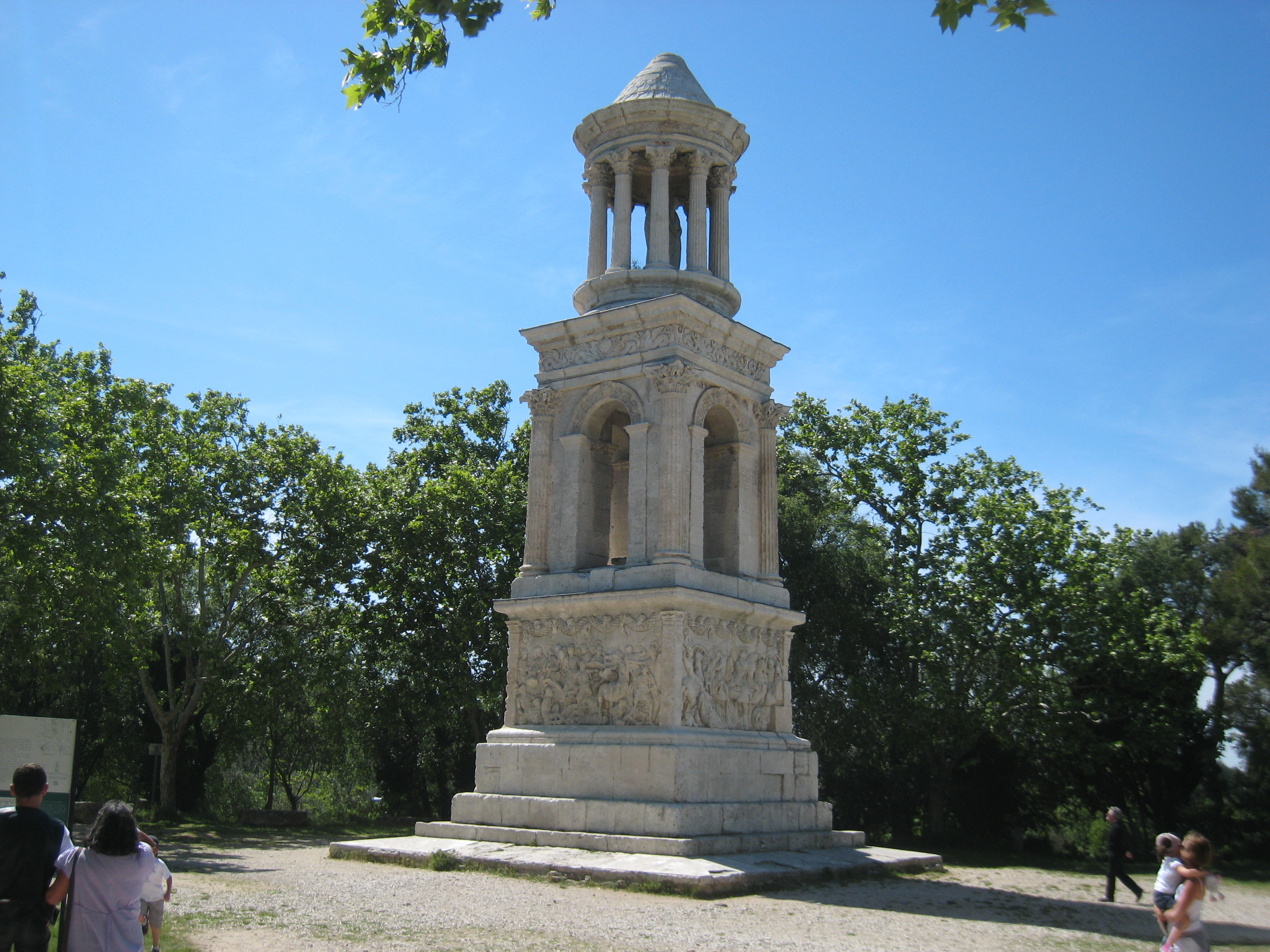
The Glanum Mausoleum
The Romans must have eaten fish, surely. Ah, but with what? Probably not fish knives and forks. Good place to buy fish knives and forks is the Sunday brocante market in the main Plane tree lined boulevard in the centre of Aix-en-P, before seeing and being seen at the Deux Garcons on the other side of the street. Seems that fish knives and forks were only thought up by the middle classes a century ago, and the elite continue to eat their fish with two forks the way they always have – so I am told. Plane tree lined streets and squares are an iconic part of the French landscape. The tall, cathedral like arches providing dappled shade for the cyclists pedalling along with a baguette sticking out of their pannier. However, not everyone takes the romantic view. Ten years ago anonymous protesters sent a message to the local newspaper at the time, complaining that they “were ‘sick to the teeth’ over the number of motorcyclists, and other motorists, who ended their days plastered against road-side trees”. A group, mainly bikers, calling themselves the ‘Anti plane tree commando’ chain-sawed down 160 plane trees in the foothills of the Pyrenees. Some councils began removing trees within a metre of traffic lanes. On-going difference of opinion. Personally, I find more hazardous the many narrow by-ways where, there is no road at all on the other side of the side marking white line, barely an inch of bitumen then a vertical drop of a metre to a drain. Scary.
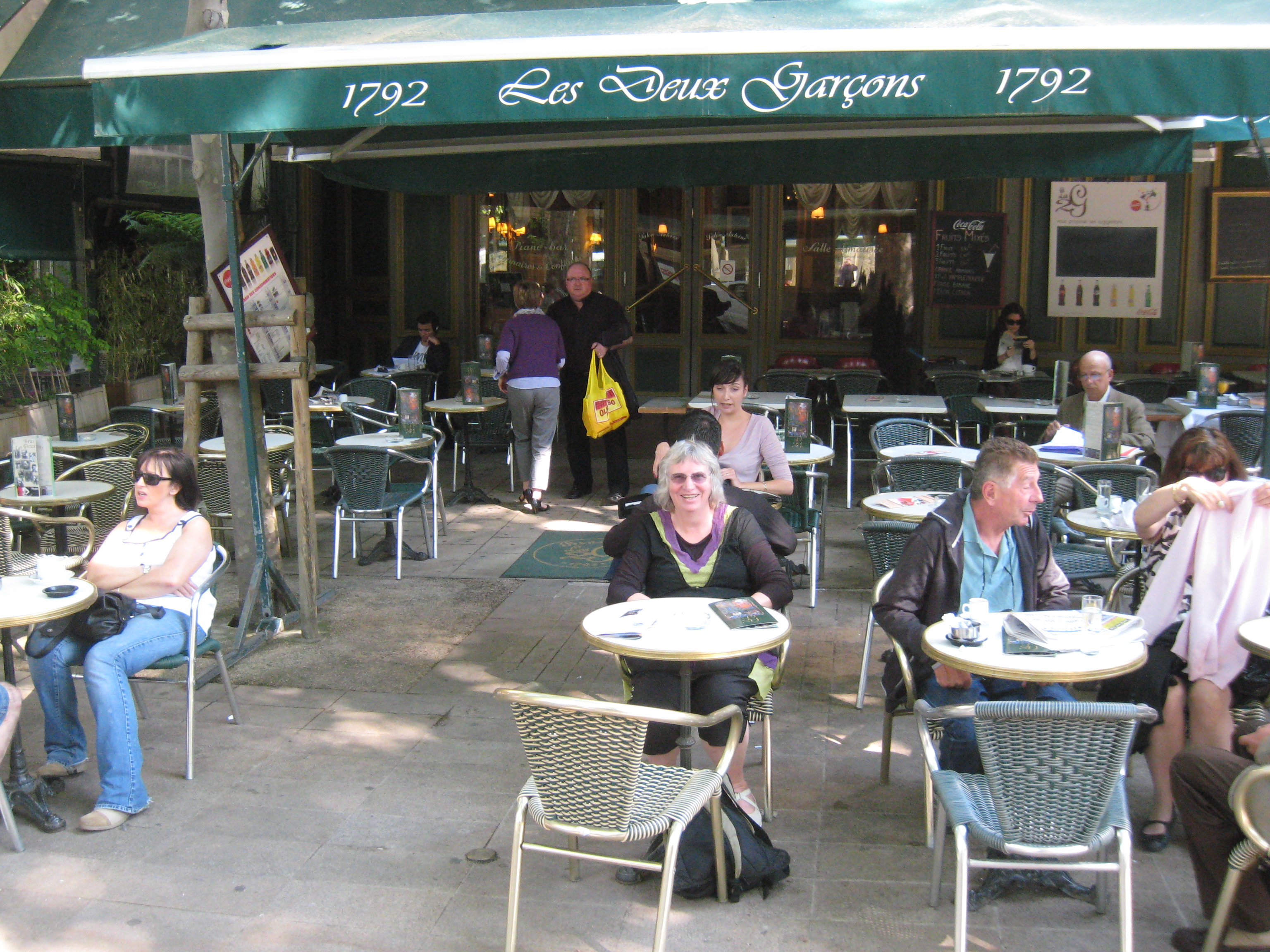
Deux Garçons
Mont St Victoire is treated by the locals with a sort of holy reverence. As mountains go, not particularly tall, but is a 500m high landmark above the surrounding rolling countryside. Most of the mountaintop is weathered smooth and white rather than craggy. Atop the peak the Croix de St Victoire is raised on high. An hour walk from the car park took us to the foot of the serious rock climbers territory, where the remaining wall of an old building stands looking up at the cross. The building dates from the 3rd century. Absolutely no access apart from foot tracks. Rocks for the wall came from the immediate vicinity and were mortared together with clay and pebbles from round about. No nearby water, so was the building a religious retreat? Roman weekender?

St. Victoire
Another little surprise in Aix-en-P was the tapestry museum which houses a collection of monumental tapestries made in the famous Belgian ‘Beauvais’ workshops in the 17th cent. Many of them about 5 m high by 8 m long, so not really the sort of thing for the lounge room & certainly not to be walked on. One almost complete set of ten depicts the Don Quixote saga of Cervantes. Around the corner, outside the Deux Garçons, Taq l’Adventurer is working the sidewalk coffee set. Equipped with an ancient vespa kitted out for Safari, he might be a character from a Tin Tin comic. He entertains with adventurer antics and closely examines the coffee drinkers with binoculars as though they might be antiquities.
 scatterbrook
It’s in reality a great and useful piece of information. I am glad
that you shared this helpful information with us. Please stay us up
to date like this. Thank you for sharing.